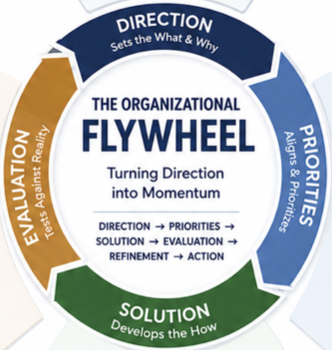
Leadership can establish strategic direction, but leadership alone can’t create the organizational movement required to turn that direction into reality. This becomes particularly challenging when collaboration is weak, functions operate in silos, or the people closest to execution aren’t meaningfully involved in shaping the solution.
The Organizational Flywheel creates a different dynamic. Executive Direction moves into a Leadership Steering Committee, then deeper into a cross-functional Champions Group and finally into individual teams that pressure-test solutions against operational reality. Their insights move back through the organization, creating a continuous cycle of direction, solution, evaluation, refinement and action.
The result is more than collaboration. People aren’t simply being asked to implement change; they’re participating in creating it. That builds commitment, develops organizational capability and creates momentum that a top-down initiative or periodic strategy event rarely can.
And the Flywheel can develop people at the same time. Rather than taking employees away from the work for courses, workshops, coaching or other traditional development activities, people build capability through experiential learning in the flow of real work—solving problems, collaborating across boundaries, making decisions and seeing the consequences.
The Organizational Flywheel is one of the mechanisms we use to operationalize strategic direction and help make strategy executable.
Read the full piece how to create momentum.